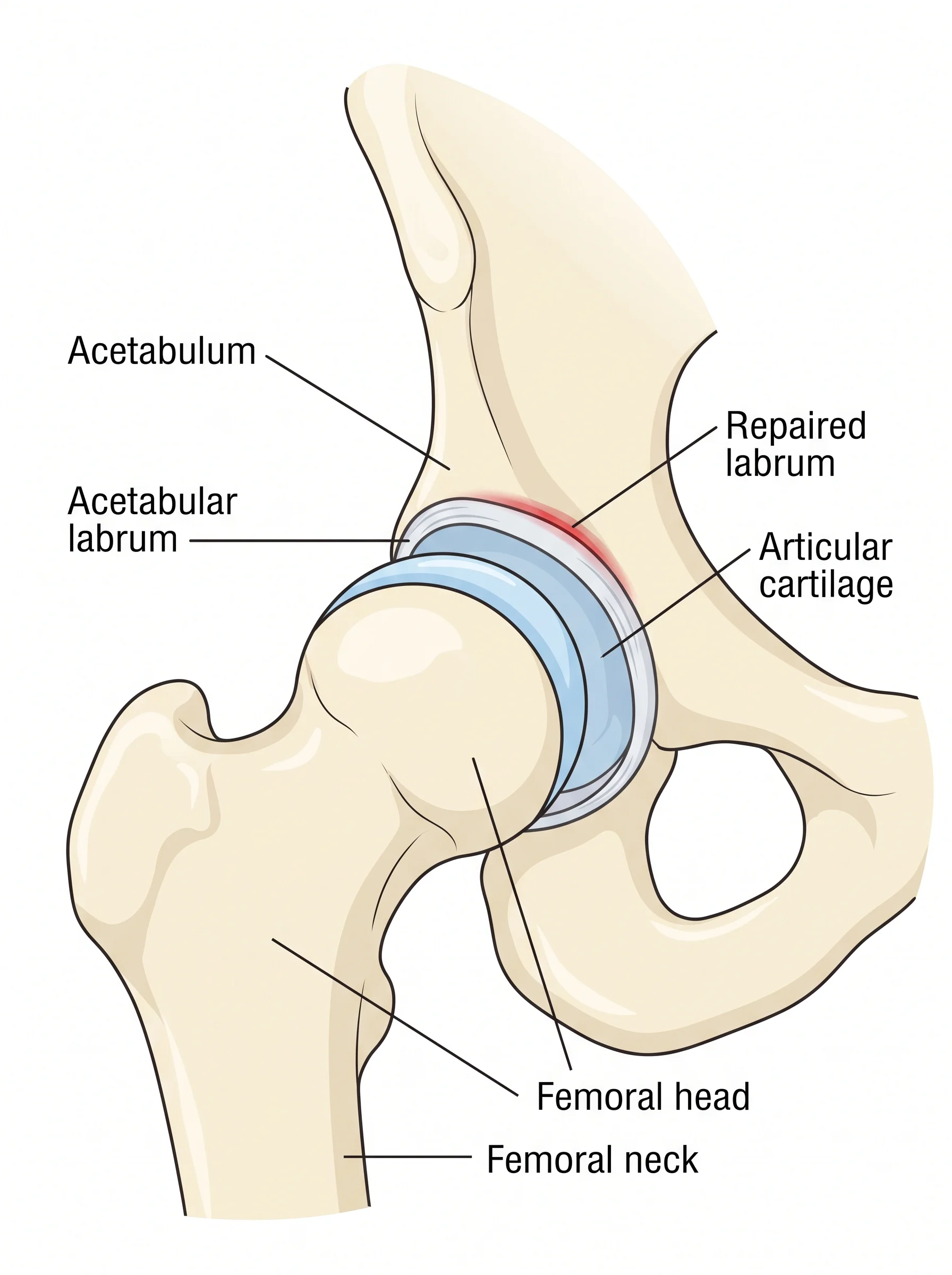
Hip labral repair is surgery that fixes a tear in the labrum, the ring of cartilage that lines the rim of the hip socket. It is most often done through hip arthroscopy, using small incisions and a camera, and is considered when a torn labrum keeps causing pain after non-surgical care.
Ross Wodicka performs hip labral repair in Fort Lauderdale when it is the right step, and reviews every alternative with you first.
What is hip labral repair?
Hip labral repair is a procedure that mends a torn labrum in the hip.
The labrum is a ring of firm cartilage (a rubbery, cushioning tissue) that lines the rim of the hip socket. It deepens the socket, helps seal the joint, and adds stability, so the ball of the thigh bone stays centered and moves smoothly. When the labrum tears, the seal and stability are disrupted, and the hip can hurt, catch, or feel unstable.
In a labral repair, the surgeon reattaches the torn cartilage to the bony rim of the socket, usually with small anchors and sutures that hold the labrum in place while it heals. The goal is to restore the labrum's seal and stability rather than simply remove the torn piece. In some cases, when tissue is too damaged to repair, the surgeon trims the frayed part instead, a step called debridement, but repair is preferred when the tissue allows it.
Labral repair is most often performed through hip arthroscopy, a minimally invasive surgery that uses a small camera and thin instruments placed through tiny incisions. A labral tear frequently occurs alongside femoroacetabular impingement, a condition in which extra bone pinches the labrum, so the surgeon often reshapes that bone during the same procedure to protect the repair.
This guide explains what the procedure involves, who tends to benefit, how recovery unfolds, and how to prepare. It is educational and does not replace a visit with a qualified surgeon.
What are the symptoms of Hip Labral Repair, and when should you see a specialist?
People with a labral tear often describe pain in the groin or the front of the hip, sometimes reaching into the thigh or buttock.
Many notice a catching, clicking, or locking feeling deep in the joint, as if something is snagging inside. Some feel the hip give way or feel unstable.
The pain frequently worsens with deep bending, prolonged sitting, pivoting, or activities such as running, twisting, or sports. Getting in and out of a car or rising from a low seat can bring it on. The discomfort often comes and goes and may linger after activity. Some people trace it to a specific injury or twist, while others cannot recall a single cause.
Labral tears appear often in active adults and in people whose hip shape, such as impingement, puts extra stress on the cartilage. Only an evaluation can confirm whether the labrum is the source.
It is reasonable to see a specialist when hip or groin pain lasts more than a few weeks, catches or locks, makes the hip feel unstable, or does not improve with rest and simple measures. Seek care sooner if you cannot bear weight after an injury, the hip looks deformed, or you have a fever with hip pain, which can signal infection.
How is Hip Labral Repair diagnosed, and what does the visit involve?
The visit begins with your history.
The surgeon asks where the pain is, what movements trigger it, whether the hip catches, clicks, or gives way, and what activities it limits. A history of a twisting injury or of hip pain with sport is useful.
A physical exam follows. The surgeon moves the hip into specific positions, often combining bending and rotation, to see which ones reproduce your pain. These maneuvers can point toward a labral tear or impingement. The surgeon also checks the back and other joints to rule out other sources.
Imaging confirms the picture. X-rays show the bones and can reveal the extra bone shape of impingement or signs of wear. An MRI shows soft tissue and can display a labral tear. Often a special MRI with contrast dye, called an MR arthrogram, is used, because the dye outlines the labrum and makes a tear easier to see. Sometimes an injection of numbing medicine into the joint helps confirm the pain is coming from inside the hip.
The surgeon combines these findings. A labral tear seen on imaging matters most when it explains your symptoms and exam. Not every tear seen on a scan needs surgery, and the degree of joint wear affects the plan. By the end of the visit, you should understand whether the labrum is the source and what your full options are.
When is Hip Labral Repair the right treatment?
Surgery is not the first step.
Non-surgical care comes first, and many labral tears become manageable without an operation.
Activity changes help. Avoiding the movements that trigger pain, such as deep squatting, repeated pivoting, or long sitting, lets the irritated tissue calm down. Cutting back on high-impact activity for a time, while staying active in low-impact ways, is often part of the plan.
Physical therapy is central. A therapist strengthens the muscles that support and control the hip, improves movement patterns, and works on flexibility. Better control around the joint can reduce the stress on the labrum and ease pain. Many people improve enough with therapy that surgery is not needed.
Medicines can control pain. Anti-inflammatory drugs, such as ibuprofen, are common, guided by your own health. An injection into the joint can reduce inflammation and can also help confirm the pain source.
Surgery becomes the right conversation when a clearly torn labrum keeps causing pain and limiting activity after a fair trial of non-surgical care, usually over weeks to months, and when the tear and any bone shape problem are ones surgery can address. Your surgeon will explain whether repair is likely to help you and whether impingement should be treated at the same time.
What happens during Hip Labral Repair, step by step?
Hip labral repair, done through arthroscopy, follows a clear sequence, with details that vary by surgeon.
You first receive anesthesia, usually general anesthesia, which puts you fully to sleep, sometimes with regional numbing added. Your anesthesia team decides with you.
To reach the labrum, the surgeon applies gentle traction to the leg, creating a small space between the ball and socket so the camera and instruments can enter without dislocating the joint. Fluid expands the joint and keeps the view clear.
The surgeon makes a few small incisions, each usually less than an inch, and inserts the arthroscope, a thin tube with a camera, through one. The magnified view appears on a screen. Through the other small incisions, the surgeon passes thin instruments.
The surgeon inspects the labrum and confirms the tear. To repair it, the surgeon places small anchors into the bony rim of the socket and uses sutures from those anchors to reattach the torn labrum to the rim, restoring its seal against the ball. If frayed tissue cannot be repaired, that portion may be trimmed instead. If impingement is present, the surgeon reshapes the extra bone on the ball or socket so it no longer pinches the repaired labrum, which helps protect the repair.
When the work is done, the instruments are removed, traction is released, and the small incisions are closed, often with a stitch or two. The procedure commonly takes one to a few hours depending on what is repaired. Afterward you move to a recovery area, where the team watches you wake and reviews your early instructions.
What is the recovery timeline for Hip Labral Repair?
Recovery is best measured by milestones, meaning what you can do, alongside typical time ranges.
The ranges below are general guidance from the American Academy of Orthopaedic Surgeons. These are ranges, not promises. A repair is often protected more carefully than a simple trimming, so your surgeon's specific instructions guide you.
First milestone: protected walking. Labral repair is usually same-day surgery, meaning you go home the day of the procedure. Most people use crutches at first, and how much weight you may place on the leg depends on the repair. Some surgeons also use a brace or limit certain motions early to protect the healing labrum.
Second milestone: off crutches and moving freely. Over the first weeks, as the repair settles, most people move off crutches and walk more freely, guided by physical therapy and by your surgeon's motion limits.
Third milestone: rebuilding strength and motion. Physical therapy over the following weeks to months rebuilds strength, motion, and control. Because the labrum needs time to heal to the bone, progress is deliberately gradual.
Fourth milestone: returning to activity and sport. Return to demanding activity and sport is a later milestone that varies with the repair and your progress, according to general guidance from the American Academy of Orthopaedic Surgeons. A repaired labrum generally calls for a more patient return than a trimmed one.
The milestones matter more than the calendar. You advance when the hip can safely handle the next step, which your surgeon and therapist judge with you. Protecting the repair early tends to support a better result.
Read the full guide to preparing for surgery →
Your own recovery instructions come from the office and are specific to you. This page describes the general course, not a plan to follow.
How should you prepare for surgery?
Preparation makes recovery smoother.
Handle these before the day of surgery.
Home setup. Clear walking paths and remove loose rugs and cords, since you will likely be on crutches. Keep everyday items within reach, and plan how to move safely around stairs. Set up a comfortable resting spot. If a brace is planned, ask how it affects sitting, sleeping, and dressing.
Transportation. You cannot drive yourself home after anesthesia. Arrange a ride for the day of surgery and for early visits until your team clears you to drive, which depends on which hip was treated and your comfort and any motion limits.
Time off. Plan time away from work based on your job and how much weight-bearing your surgeon allows. Desk work often allows an earlier return than active or standing work. Ask your surgeon.
Who to have available. Arrange for an adult to stay with you the first day and to help with meals, errands, and daily tasks while you are on crutches or in a brace. Prepare simple meals ahead.
Health preparation. Follow instructions on pausing certain medicines and on when to stop eating and drinking before surgery. Set up your physical therapy in advance, since a guided, well-timed program protects the repair. Bring a list of your medicines.
Which warning signs should you call about?
Most recoveries go smoothly.
Knowing the warning signs keeps you safe. Call your surgeon's office if you notice any of these.
Signs of possible infection: a fever, growing redness or warmth around an incision, drainage from a wound, or pain that worsens rather than eases.
Signs of a possible blood clot: new pain, swelling, tenderness, or redness in the calf or leg.
Other reasons to call: numbness or tingling in the leg, foot, or groin that does not go away, which can follow the traction used during surgery and usually settles but should be reported; a sudden increase in pain or a feeling that something shifted in the hip, which matters because the repair is healing; loss of the ability to bear weight your surgeon allowed; an incision that opens; or pain not controlled by your plan.
Seek emergency care right away, by calling your local emergency number, if you have chest pain, sudden shortness of breath, or trouble breathing, which can signal a clot that has traveled to the lungs. This is an emergency.
Keep your surgeon's office number and after-hours contact easy to find before you go home. When in doubt, call.
What results can you expect from Hip Labral Repair?
Hip labral repair has a track record for well-selected patients.
According to general guidance from the American Academy of Orthopaedic Surgeons, repairing a torn labrum, often alongside correcting impingement, can reduce pain and improve function for suitable patients, and preserving the labrum supports the joint's seal and stability. Repairing the labrum is generally preferred over removing it when the tissue allows, because the labrum plays a real role in how the hip works.
General guidance from the American Academy of Orthopaedic Surgeons also notes that outcomes depend on patient selection, on treating any underlying bone shape problem, and on the amount of existing joint wear. When arthritis is already advanced, a labral repair is less likely to relieve symptoms, and some patients may still need other treatment over time.
Complications are uncommon but possible and can include infection, blood clots, temporary numbness from traction, stiffness, or incomplete relief, according to general guidance from the American Academy of Orthopaedic Surgeons.
The honest summary: for the right tear in the right patient, repairing the labrum and addressing its cause can relieve pain and restore function through small incisions, with results tied closely to selection and to the health of the joint. These are ranges drawn from general orthopedic guidance, not promises about your result.
What do patients ask most?
Is my labrum repaired or removed?+
Will impingement be treated at the same time?+
How long will I be on crutches?+
When can I return to sports?+
Does insurance cover hip labral repair?+
Fellowship trained at Southern California Orthopedic Institute, Los Angeles (Sports Medicine). Sees patients in Fort Lauderdale.
About Dr. Wodicka →