Total shoulder replacement is surgery that replaces the worn ball and socket of the shoulder with smooth implants. Dr. Wodicka performs total shoulder replacement in Fort Lauderdale for advanced arthritis, after non-surgical care such as therapy and injections has been tried, to relieve pain and restore motion.
Ross Wodicka performs total shoulder replacement in Fort Lauderdale when it is the right step, and reviews every alternative with you first.
What is Total Shoulder Replacement?
Total shoulder replacement, also called total shoulder arthroplasty, replaces the damaged surfaces of the shoulder joint with artificial parts.
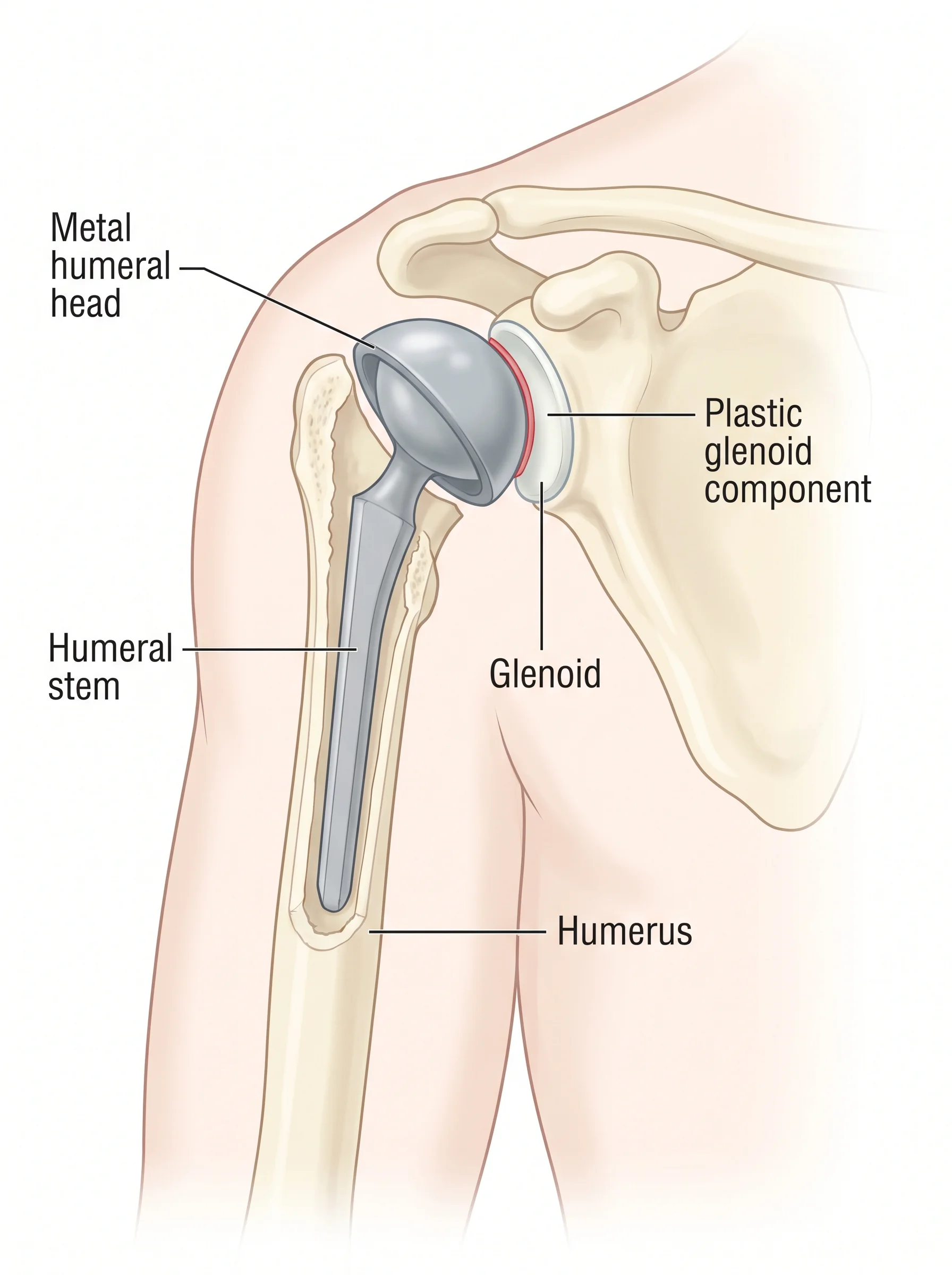
The shoulder is a ball-and-socket joint. In this surgery, the worn ball at the top of the arm bone is replaced with a smooth metal ball, and the socket is resurfaced with a smooth plastic piece.
It is most often done for advanced osteoarthritis, the gradual wearing of cartilage, when the rotator cuff tendons are still working well. This standard replacement relies on those tendons to move and stabilize the new joint.
Replacement is considered after non-surgical care no longer keeps the shoulder comfortable enough for daily life. It is a planned choice, not an emergency. The sections below cover what is tried first and what the surgery involves.
What happens during Total Shoulder Replacement, step by step?
During total shoulder replacement, Dr. Wodicka makes an incision at the front of the shoulder to reach the joint.
The worn ball at the top of the arm bone is removed and replaced with a smooth metal ball on a stem that fits into the bone. The socket is resurfaced with a smooth plastic piece that is secured in place. Together these create a new, smooth joint. This standard replacement depends on healthy rotator cuff tendons to move and steady the shoulder, which is why the cuff is checked before surgery. When the rotator cuff is badly torn, a different design called reverse shoulder replacement may fit better. Most people stay in the hospital briefly after surgery.
What is recovery like after Total Shoulder Replacement?
Recovery from total shoulder replacement happens in stages over months.
Most people wear a sling early on and begin gentle guided motion soon after surgery to protect the new joint while it settles.
Physical therapy progresses from protected motion, to active movement, to strengthening. Many people return to light daily activities within several weeks, while fuller motion and strength commonly develop over about four to six months, according to general guidance from the American Academy of Orthopaedic Surgeons. These are ranges, not promises. Your timeline depends on your health before surgery, your rehabilitation, and the demands of your daily life. Your surgical team will map it with you.
Read the full guide to preparing for surgery →
Your own recovery instructions come from the office and are specific to you. This page describes the general course, not a plan to follow.
What do patients ask most?
When is total shoulder replacement the right choice?+
What is the difference between total and reverse shoulder replacement?+
How long does recovery take after shoulder replacement?+
How long do shoulder replacements last?+
What are the treatment options?
- 01Activity changes to reduce motions that trigger painActivity changes to reduce motions that trigger pain.
- 02Physical therapy to keep the joint moving and strengthen supporting musclesPhysical therapy to keep the joint moving and strengthen supporting muscles.
- 03Anti-inflammatory medicine for pain and swellingAnti-inflammatory medicine for pain and swelling.
- 04A corticosteroid injection, a shot that reduces inflammation in the joint, for periods ofA corticosteroid injection, a shot that reduces inflammation in the joint, for periods of higher pain.
- 05Total shoulder replacement, offered when pain and stiffness limit daily life despite non-sTotal shoulder replacement, offered when pain and stiffness limit daily life despite non-surgical care and the rotator cuff is intact.
Fellowship trained at Southern California Orthopedic Institute, Los Angeles (Sports Medicine). Sees patients in Fort Lauderdale.
About Dr. Wodicka →