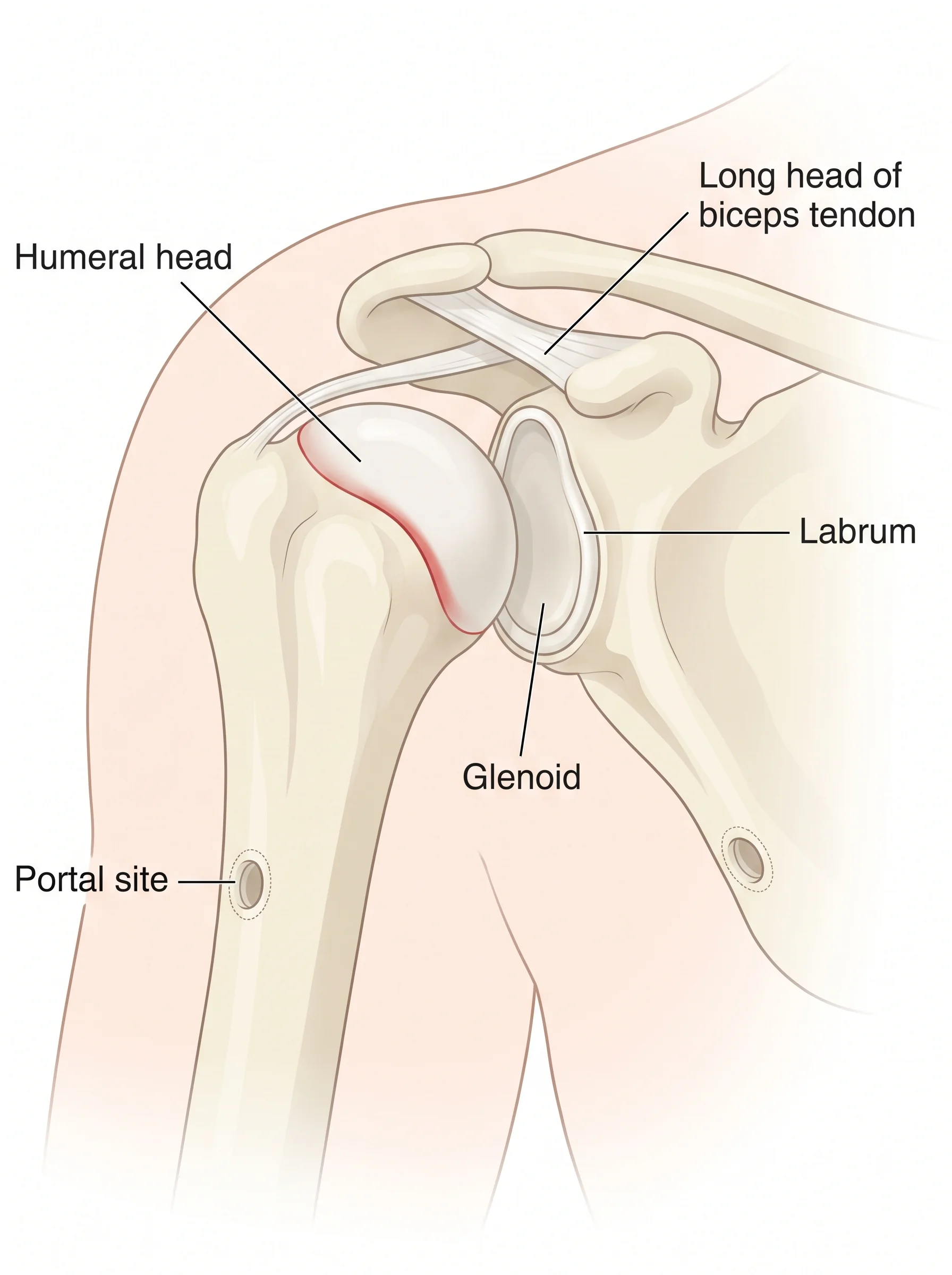
Shoulder arthroscopy is a procedure that uses a small camera through tiny incisions to diagnose and treat problems inside the shoulder. Dr. Wodicka performs shoulder arthroscopy in Fort Lauderdale after non-surgical care has been tried, to repair torn tissue, remove damaged tissue, or address impingement when symptoms continue.
Ross Wodicka performs shoulder arthroscopy in Fort Lauderdale when it is the right step, and reviews every alternative with you first.
What is Shoulder Arthroscopy?
Shoulder arthroscopy is surgery done with an arthroscope, a small camera passed through tiny incisions, along with thin instruments.
The camera sends a view of the inside of the joint to a screen, so the surgeon can both see the problem and treat it through small openings rather than one large incision.
It is used for many shoulder problems, including rotator cuff tears, labral tears, and impingement, which is pinching of soft tissue in the shoulder. Because the openings are small, arthroscopy is often chosen when the problem can be reached and treated this way.
Arthroscopy is considered after non-surgical care has been tried and symptoms continue. The sections below cover what is tried first and what the procedure itself involves.
What happens during Shoulder Arthroscopy, step by step?
During shoulder arthroscopy, Dr. Wodicka makes a few small incisions around the shoulder.
Through one, the arthroscope, a small camera, is placed to view the joint on a screen. Through the others, thin instruments are used to repair or remove tissue, depending on the problem. Fluid is passed through the joint to open the space and give a clear view. The specific work varies: a torn labrum may be reattached, a frayed area cleaned, or a pinched space opened up. Arthroscopy is usually an outpatient procedure, meaning most people go home the same day. The small incisions are closed with sutures or small strips.
What is recovery like after Shoulder Arthroscopy?
Recovery from shoulder arthroscopy depends heavily on what was done inside the joint, since arthroscopy is a way of reaching the shoulder, not a single operation.
A simple cleanup recovers faster than a tendon or labral repair.
For many arthroscopic procedures, people use a sling for a period, then begin guided motion and progress to strengthening over weeks to months. Return to light activity often comes within a few weeks, while return to demanding tasks or sports can take several months when a repair was performed, with ranges commonly cited around four to six months for tissue repairs, according to general guidance from the American Academy of Orthopaedic Surgeons. These are ranges, not promises. Your timeline depends on the specific procedure and your rehabilitation, which your surgical team will map with you.
Read the full guide to preparing for surgery →
Your own recovery instructions come from the office and are specific to you. This page describes the general course, not a plan to follow.
What do patients ask most?
What is shoulder arthroscopy used for?+
Is shoulder arthroscopy an outpatient procedure?+
How long is recovery after shoulder arthroscopy?+
How big are the incisions in shoulder arthroscopy?+
What are the treatment options?
- 01Physical therapy to strengthen the shoulder and restore balanced motionPhysical therapy to strengthen the shoulder and restore balanced motion.
- 02Activity changes to rest the joint and avoid movements that trigger painActivity changes to rest the joint and avoid movements that trigger pain.
- 03Anti-inflammatory medicine for pain and swellingAnti-inflammatory medicine for pain and swelling.
- 04A corticosteroid injection, a shot that reduces inflammation, in selected casesA corticosteroid injection, a shot that reduces inflammation, in selected cases.
- 05Shoulder arthroscopy, offered when these steps do not relieve symptoms and a problem insidShoulder arthroscopy, offered when these steps do not relieve symptoms and a problem inside the joint can be treated this way.
Fellowship trained at Southern California Orthopedic Institute, Los Angeles (Sports Medicine). Sees patients in Fort Lauderdale.
About Dr. Wodicka →