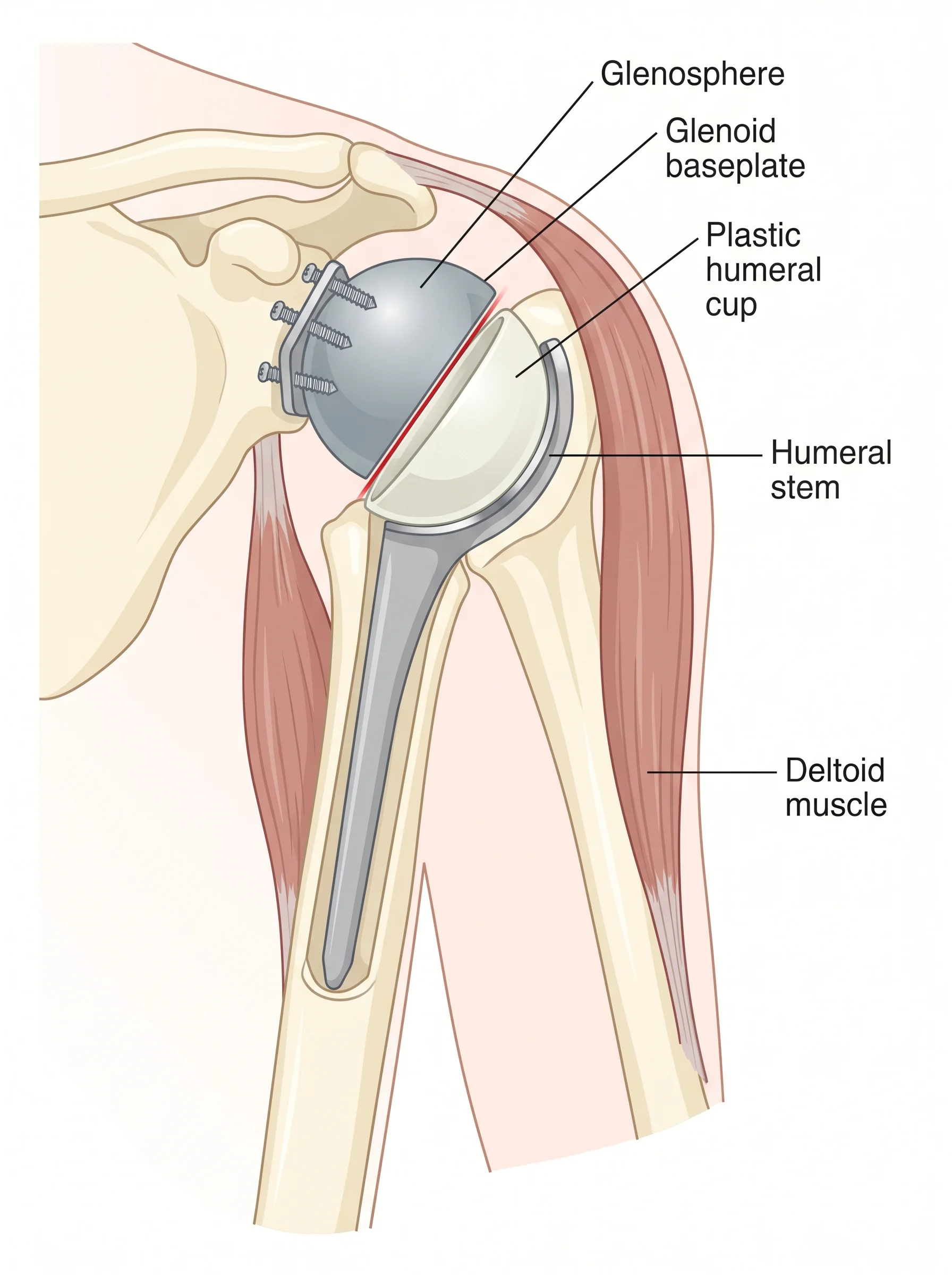
Reverse shoulder replacement is surgery that rebuilds the shoulder joint with the ball and socket switched to opposite sides. This design lets other muscles power the arm when the rotator cuff is badly torn. It is used for cuff-related arthritis and some complex fractures. It relieves pain and restores motion for most patients over several months.
Ross Wodicka performs reverse shoulder replacement in Fort Lauderdale when it is the right step, and reviews every alternative with you first.
What is reverse shoulder replacement, and who is it for?
Reverse shoulder replacement is a procedure that replaces the shoulder joint with artificial parts arranged in reverse, so the ball sits where the socket was and the socket sits where the ball was.
The shoulder is normally a ball-and-socket joint powered in part by the rotator cuff, the group of tendons that lift and steady the arm. When the cuff is badly torn or worn away, a standard replacement cannot work well because the muscles that would move it are gone.
Reversing the parts changes the mechanics. It lets the deltoid, the large muscle on the outside of the shoulder, do the work of lifting the arm in place of the missing cuff. This is why reverse replacement helps people whom a standard replacement cannot.
Reverse replacement is used mainly for two situations. The first is cuff tear arthropathy, meaning arthritis that develops when a large, long-standing rotator cuff tear leads to joint wear. The second is certain complex fractures of the upper end of the arm bone and some failed earlier shoulder surgeries. This page explains what these problems feel like, how they are diagnosed, the non-surgical care that comes first when possible, and what the surgery and recovery involve.
What do the symptoms feel like, and when should you see a specialist?
The symptoms that lead to reverse shoulder replacement are usually shoulder pain combined with weakness and loss of the ability to lift the arm.
Patients often describe.
- Deep shoulder pain that worsens with activity and disturbs sleep. - Marked weakness, so the arm feels hard to raise or cannot be raised overhead. - A sense that the shoulder does not do its job even though effort is there. - Stiffness and difficulty with dressing, reaching, and daily tasks. - In the case of a fracture, sudden severe pain and inability to use the arm after an injury.
A hallmark of cuff-related shoulder problems is the combination of pain and true weakness, where the arm will not lift no matter the effort. It is reasonable to see a shoulder specialist when pain and weakness limit daily life, when you cannot raise the arm, or after a significant shoulder injury. A specialist can determine whether the rotator cuff is intact and whether reverse replacement fits your situation better than other options. This page describes patterns and does not diagnose. An in-person exam and imaging are needed to find the cause.
How is the shoulder diagnosed before reverse replacement?
Diagnosis combines your history, a physical exam, and imaging, with special attention to the rotator cuff.
The visit begins with questions about pain, weakness, prior injuries or surgeries, and how the shoulder affects daily life.
The exam tests motion and strength and checks whether you can raise the arm actively. Loss of active lifting with a preserved passive range, meaning the surgeon can move the arm but you cannot, points toward a cuff that no longer works.
Imaging confirms the picture. X-rays show the joint and can reveal arthritis, the high position of the ball that suggests a large cuff tear, and fracture patterns. An MRI shows the rotator cuff and how much tendon and muscle remain. A CT scan gives detailed bone information used to plan the placement of the new socket. Together these findings tell the surgeon whether reverse replacement is the right design for your shoulder.
[CTA: To have a painful, weak shoulder evaluated, request a visit with Dr. Wodicka. Contact details are on the contact page.]
What happens during Reverse Shoulder Replacement, step by step?
Reverse shoulder replacement places a metal ball on the shoulder blade side and a socket on the arm bone side, the opposite of the natural arrangement.
It is done through an incision at the front of the shoulder.
- Anesthesia. You receive anesthesia so you feel no pain, often a nerve block that numbs the arm along with general anesthesia. The anesthesia team reviews the plan with you. - Reaching the joint. The surgeon makes an incision at the front of the shoulder and moves the muscles aside to reach the joint. - Preparing the socket side. The worn socket on the shoulder blade is prepared, and a metal base with a rounded ball is fixed to it. This is the reversed ball. - Preparing the arm side. The upper end of the arm bone is shaped to hold a stem, and a plastic socket is attached to it. This is the reversed cup. - Setting the joint. The new socket on the arm is seated over the new ball on the shoulder blade, and the surgeon checks that the shoulder moves and is stable. The design uses the deltoid muscle to lift the arm. - Closing. The incision is closed and the arm is placed in a sling.
Reverse shoulder replacement usually involves a short hospital stay of a day or so, though some patients go home the same day depending on their health and their surgeon's plan. The care team will explain what to expect for your case.
What is the recovery timeline for Reverse Shoulder Replacement?
Recovery from reverse shoulder replacement is gradual and measured by what you can do as much as by the calendar.
The stages below give milestones alongside typical ranges. These are ranges, not promises. Your timeline depends on your health, whether the surgery followed a fracture, and your rehabilitation.
Early recovery (roughly the first 2 to 6 weeks). The incision heals and swelling settles. You wear a sling and begin gentle motion as directed. Reverse replacement often allows earlier, protected motion than some other shoulder surgeries because it does not rely on a cuff repair to heal. Milestone: you can manage the sling, sleep supported, and do gentle motion without sharp pain.
Restoring motion (roughly 6 to 12 weeks). You gradually move the arm under your own power, often noticing you can lift it more easily than before surgery as the deltoid takes over. Milestone: you can raise the arm through more of its range and handle light daily tasks.
Rebuilding strength (roughly 3 to 6 months). Therapy builds strength and control. Milestone: you regain useful strength for everyday reaching and lifting within the limits your surgeon sets.
Full recovery (often up to a year). Gains continue over many months. According to general guidance from the American Academy of Orthopaedic Surgeons, recovery of comfortable function after reverse shoulder replacement commonly takes several months, with improvement continuing up to about a year. These are ranges, not promises. Your surgeon will set limits on heavy lifting to protect the replacement.
Read the full guide to preparing for surgery →
Your own recovery instructions come from the office and are specific to you. This page describes the general course, not a plan to follow.
How should you prepare for surgery?
Planning ahead makes recovery easier, because your arm will be in a sling and limited for several weeks.
Use the time before surgery to get ready.
At home. Set everyday items at waist to chest height. Stock simple meals. Lay out loose, front-opening shirts, which are far easier than pullovers with a sling. A recliner or wedge pillow helps many people sleep more comfortably.
Transportation. Arrange a ride home and rides to early appointments. You cannot drive while in the sling or while taking medicine that causes drowsiness. Your surgeon will say when driving is safe again.
Time off. Plan work time based on your job. Desk work often resumes within a few weeks with the arm supported, while physical or overhead jobs need much longer. Ask your surgeon for guidance specific to your work.
Help on hand. Arrange for someone to stay with you for the first few days to help with meals, dressing, bathing, and tasks that need two hands. This matters especially if the surgery followed a fracture, when the other arm may also be sore.
Health prep. Follow all instructions about medicines to stop or continue and about not eating or drinking before surgery. Your team may ask for a medical check-up beforehand. If you use tobacco, reducing it before surgery supports healing.
Which warning signs should you call about?
Most recoveries are smooth, but some signs need a prompt call to the surgical office.
Call the office if you have.
- Fever, chills, or spreading redness and warmth around the incision, which can signal infection. - Drainage of pus or a foul smell from the incision. - Pain that suddenly worsens and is not eased by your prescribed medicine. - Numbness, tingling, or fingers that turn pale or blue and do not improve with position changes. - A shoulder that feels like it has shifted, popped out, or will not move as it did, which can signal the joint has come apart. - Calf pain or swelling, or new shortness of breath or chest pain.
New shortness of breath, chest pain, or a swollen, painful calf can signal a blood clot and is a reason to seek emergency care right away by calling your local emergency number. A shoulder that suddenly looks or feels dislocated also needs prompt attention. For questions about the incision, the sling, medicine, or activity, call the surgical office, and use the on-call number after hours. It is always fine to call with a question.
What results can you expect from Reverse Shoulder Replacement?
Reverse shoulder replacement relieves pain and restores the ability to lift the arm for most patients whose rotator cuff can no longer do that work.
According to general guidance from the American Academy of Orthopaedic Surgeons, most people who have reverse shoulder replacement for cuff-related arthritis experience less pain and improved ability to raise the arm. Results depend on the strength of the deltoid muscle, the reason for surgery, and rehabilitation.
Reverse replacements are durable, and many function well for years, according to general orthopaedic literature summarized by the American Academy of Orthopaedic Surgeons. As with any joint replacement, parts can wear or loosen over time, and reverse replacement carries its own set of risks that your surgeon will review, including the small chance the joint can dislocate. Outcomes after surgery for a fracture can differ from outcomes for arthritis. Your surgeon can explain what your situation means for your likely result. These are general ranges, not promises for any one person.
What do patients ask most?
Why is it called a reverse replacement?+
Who needs a reverse replacement instead of a standard one?+
Will I be able to lift my arm again?+
How long will I wear the sling?+
How long does a reverse replacement last?+
What will it cost?+
What are the treatment options?
- 01Activity changesAdjusting how you use the arm and avoiding painful overhead tasks can lower daily pain.
- 02Physical therapyExercises strengthen the remaining muscles, especially the deltoid and the muscles around the shoulder blade, which can improve function even with a torn cuff.
- 03Anti-inflammatory medicineOver-the-counter or prescribed medicine can ease pain and swelling. Ask a pharmacist or physician what is safe for you.
- 04InjectionsA cortisone injection can reduce inflammation and provide relief for a period of time.
Fellowship trained at Southern California Orthopedic Institute, Los Angeles (Sports Medicine). Sees patients in Fort Lauderdale.
About Dr. Wodicka →