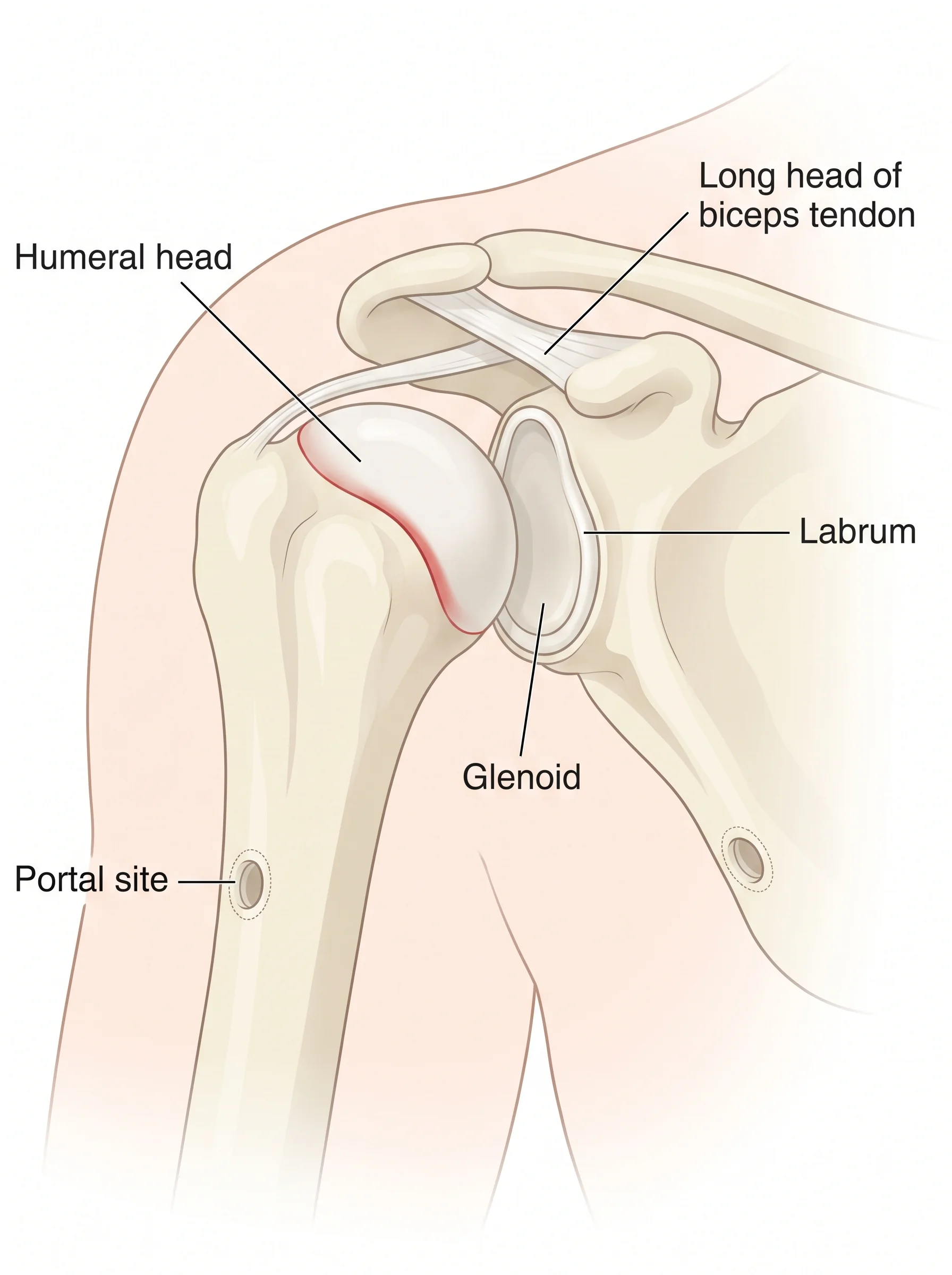
Shoulder arthroscopy is surgery that uses a small camera and thin instruments through tiny cuts to see and treat problems inside the shoulder. Surgeons use it to repair tears, remove damaged tissue, and smooth bone spurs. It is chosen when non-surgical care has not eased pain. Most people go home the same day.
Ross Wodicka performs shoulder arthroscopy in Fort Lauderdale when it is the right step, and reviews every alternative with you first.
What is shoulder arthroscopy, and who is it for?
Shoulder arthroscopy is a procedure that lets a surgeon look inside the shoulder joint and repair problems using a pencil-sized camera and thin instruments passed through small cuts.
Arthroscopy means "to look within the joint." Because the cuts are small, it is often called minimally invasive.
Arthroscopy is a tool, not a single operation. Surgeons use it to treat several shoulder conditions, including rotator cuff tears, a torn labrum (the rim of cartilage that deepens the socket), shoulder impingement (tissue pinching under a bone), inflamed bursa or lining, loose fragments of cartilage or bone, and early stiffness from a frozen shoulder. What is done during the procedure depends on what is found and what was planned.
Shoulder arthroscopy is usually considered after non-surgical care has been tried and pain or loss of function continues. It helps people whose imaging and exam point to a problem inside the joint that surgery can address. This page explains the symptoms that lead to it, how the shoulder is evaluated, the non-surgical options that come first, and what the procedure and recovery involve.
What do the symptoms feel like, and when should you see a specialist?
Symptoms that lead to shoulder arthroscopy usually include ongoing shoulder pain, catching or locking, weakness, or a feeling that the shoulder is loose or unstable.
The specific pattern depends on the underlying problem.
Patients often describe:
- Pain with overhead reaching or lifting that has not gone away with rest and therapy. - A catching, popping, or grinding sensation deep in the shoulder. - A sense that the shoulder slips or feels loose, especially with certain arm positions. - Pain at night that disturbs sleep. - Stiffness and loss of motion that limit dressing, reaching, or work.
It is reasonable to see a shoulder specialist when pain lasts more than a few weeks despite rest and home care, when the shoulder catches or gives way, or when weakness or stiffness limits daily tasks. Sudden loss of motion or strength after an injury is a reason to be seen sooner. A specialist sorts out whether the problem is in the tendons, the labrum, the joint surface, or the surrounding tissue. This page describes patterns and does not diagnose. An in-person exam is needed to find the cause.
How is the shoulder evaluated before arthroscopy?
Evaluation combines your history, a physical exam, and imaging so the surgeon knows what to expect inside the joint.
The visit begins with questions about how the pain started, what makes it better or worse, and how it affects daily life and sleep.
The exam tests motion, strength, and stability. The surgeon moves the arm through different positions to find what reproduces the pain and to check whether the shoulder feels loose. Particular tests point toward the rotator cuff, the labrum, or impingement.
Imaging confirms the picture. X-rays show the bones and can reveal spurs, arthritis, or signs of past injury. An MRI, which uses a magnet and radio waves, shows soft tissue such as tendons and the labrum. Sometimes a dye is placed in the joint before the MRI to outline the labrum more clearly, a study called an MRI arthrogram. These findings, along with your exam, tell the surgeon whether arthroscopy is likely to help and what it would involve.
[CTA: To have a shoulder problem evaluated, request a visit with Dr. Wodicka. Contact details are on the contact page.]
What happens during Shoulder Arthroscopy, step by step?
Shoulder arthroscopy uses a small camera to guide repairs done with thin instruments through several small cuts.
The exact steps depend on what is treated, but the general sequence is the same.
- Anesthesia. You receive anesthesia so you feel no pain, often a nerve block that numbs the arm along with sedation or general anesthesia. The anesthesia team reviews the plan with you. - Positioning. You are positioned so the surgeon can move the arm freely, either lying on your side or in a semi-seated position. - Camera placement. The surgeon makes a small cut and inserts the arthroscope, which sends a magnified image to a screen. Saltwater fluid gently expands the joint for a clear view. - Inspection. The surgeon examines the joint surfaces, the rotator cuff, the labrum, and the surrounding tissue, and confirms the problem. - Treatment. Through one or more additional small cuts, thin instruments carry out the repair. This may mean reattaching a tendon or the labrum with anchors and sutures, removing inflamed or loose tissue, or smoothing a bone spur. The specific work matches your diagnosis. - Closing. The small cuts are closed and a dressing is applied. Depending on what was done, your arm may be placed in a sling.
Shoulder arthroscopy is usually outpatient, meaning you go home the same day. The recovery that follows depends on what was treated. A simple cleanup heals faster than a tendon or labral repair, which must be protected while it heals.
What is the recovery timeline for Shoulder Arthroscopy?
Recovery from shoulder arthroscopy depends heavily on what was done inside the joint, and it is measured by what you can do as much as by the calendar.
The stages below give milestones alongside typical ranges. These are ranges, not promises. A minor procedure recovers faster than a repair that must heal to bone.
Early recovery (roughly the first 1 to 2 weeks). The small cuts begin to heal and swelling settles. Milestone: you can manage the dressing and any sling, control pain with your plan, and do gentle motion as directed.
Restoring motion (roughly 2 to 6 weeks). Guided by your surgeon and therapist, you regain range of motion. If a tendon or labrum was repaired, motion is advanced slowly to protect it. Milestone: you can move the arm through a wider range and handle light daily tasks.
Rebuilding strength (roughly 6 weeks to 3 months). Therapy adds resistance once tissues have healed enough. Milestone: you regain strength for everyday lifting and reaching.
Full activity. For a simple debridement, meaning removal of damaged tissue, many people return to normal activity within weeks. When a repair is done, return to sports, heavy lifting, and overhead work takes longer, often several months. According to general guidance from the American Academy of Orthopaedic Surgeons, recovery after shoulder arthroscopy ranges from a few weeks for minor procedures to several months when a tendon or labrum is repaired. These are ranges, not promises, and your surgeon will map yours.
Read the full guide to preparing for surgery →
Your own recovery instructions come from the office and are specific to you. This page describes the general course, not a plan to follow.
How should you prepare for surgery?
Planning ahead makes the first weeks smoother, especially if your arm will be in a sling.
Use the time before surgery to prepare.
At home. Keep everyday items within easy reach at waist to chest height. Stock simple meals. Choose loose, front-opening shirts, which are easier than pullovers with a sore or slung arm. A recliner or wedge pillow helps many people sleep.
Transportation. Arrange a ride home, since you cannot drive after anesthesia. Line up rides for early appointments too, because you should not drive while in a sling or while taking medicine that causes drowsiness. Your surgeon will say when driving is safe again.
Time off. Plan work time based on your job and what is being treated. Desk work may resume within days to a couple of weeks, while physical or overhead jobs need longer. Ask your surgeon for guidance specific to your situation.
Help on hand. Have someone available for the first day or two to help with meals, dressing, and tasks that need two hands.
Health prep. Follow instructions about medicines to stop or continue and about not eating or drinking before surgery. If you use tobacco, cutting back before surgery supports healing.
Which warning signs should you call about?
Most recoveries go well, but some signs need a prompt call to the surgical office.
Call the office if you notice the following.
- Fever, chills, or spreading redness and warmth around a cut, which can signal infection. - Drainage of pus or a bad smell from an incision. - Pain that suddenly worsens and is not eased by your prescribed medicine. - Numbness, tingling, or fingers that turn pale or blue and do not improve with position changes. - Calf pain or swelling, or new shortness of breath or chest pain.
New shortness of breath, chest pain, or a swollen, painful calf can signal a blood clot and is a reason to seek emergency care right away by calling your local emergency number. For questions about incisions, the sling, medicine, or activity, call the surgical office, and use the on-call number after hours. It is always fine to call with a question.
What results can you expect from Shoulder Arthroscopy?
Shoulder arthroscopy relieves pain and improves function for most patients, with results shaped by the problem treated.
According to general guidance from the American Academy of Orthopaedic Surgeons, minimally invasive shoulder arthroscopy generally involves less soft-tissue disruption than open surgery, which can support recovery. Outcomes depend on the specific condition, the tissue quality, and how closely rehabilitation is followed.
Because arthroscopy treats many different problems, there is no single success figure that fits every case. A cleanup of inflamed tissue, a rotator cuff repair, and a labral repair each have their own expected course. Your surgeon can explain the likely result for your specific procedure. In general terms, most patients who have shoulder arthroscopy for a clearly identified problem report meaningful improvement, according to general orthopaedic literature summarized by the American Academy of Orthopaedic Surgeons. These are general ranges, not promises.
What do patients ask most?
Is shoulder arthroscopy the same as open surgery?+
Will I need a sling afterward?+
Is it outpatient?+
How soon can I return to work?+
Will arthroscopy fix my shoulder for good?+
What will it cost?+
What are the treatment options?
- 01Activity changesReducing the motions that trigger pain, such as repeated overhead reach, lets irritated tissue settle.
- 02Physical therapyTargeted exercises restore motion and strengthen the muscles that stabilize the shoulder, which often improves symptoms on its own.
- 03Anti-inflammatory medicineOver-the-counter or prescribed medicine can lower pain and swelling. Ask a pharmacist or physician what is safe for you.
- 04InjectionsA cortisone injection can reduce inflammation and pain and can make therapy more comfortable.
Fellowship trained at Southern California Orthopedic Institute, Los Angeles (Sports Medicine). Sees patients in Fort Lauderdale.
About Dr. Wodicka →